Waiting for Snow: Cautious Excitement in November
I usually resist getting swept up in early-season weather hype, but this time the forecast has me watching the sky. Snow showed up in the models over the weekend and, at first, I treated it like background noise. After last winter’s disappointment—when I missed both the White Christmas and a hoped-for January storm—I decided I wouldn’t let a tentative November prediction stir me into a frenzy.
Friends who know me are probably surprised. They know I love a good snowfall, and they’re likely laughing at the idea that I’m trying not to count my snowflakes before they fall. I’ve learned to be cautious. Too many times the system arrives only to be swallowed by our valley’s late-fall warmth, changing flakes into slushy rain before they can settle.
Tuscaloosa, specifically, tends to sit in a kind of heat bubble. I’ve watched snow approach on radar only to melt as it crosses the county line, while neighboring areas get the white stuff. It’s a small, frustrating pattern: the storm teases us, spills snow where it can, and leaves us wondering what might have been. That experience has taught me to stay grounded and not get carried away by early forecasts.
Still, a weather map shared online piqued my interest. Seeing the potential track laid out visually—bands of precipitation and cold air—brought back that familiar thrill. Images of predicted accumulation and storm paths have a way of making the possibility feel more real, even when the outcome is still uncertain.
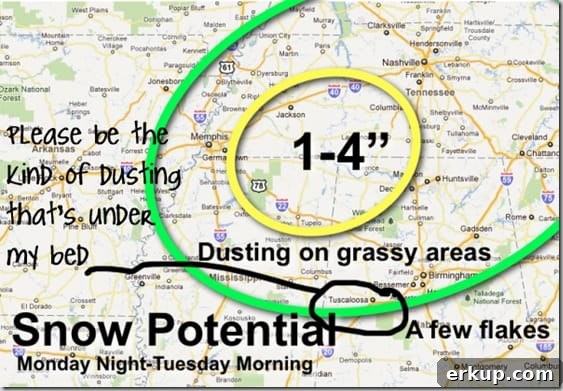
Unlike last winter, when I let wishful thinking get the better of me, this time I’m keeping expectations modest. I’ll watch the updates and keep a close eye on local forecasts, but I won’t plan a parade just yet. The weather here has a way of humbling hopeful predictions. That said, if the conditions line up and the temperature holds, I’ll be the first one at the window celebrating.
For anyone else watching the same data, a few sensible expectations can help. First, early-season storms often come with fluctuations: what looks like snow on the map can turn to sleet or rain if surface temperatures are marginal. Second, localized conditions—urban heat, terrain, or a warm pocket of air—can make a big difference between a dusting and a measurable snowfall. Finally, timing matters: if the cold air arrives only in the upper levels while the surface stays mild, precipitation will likely fall as rain.
I’ll be doing something simple while I wait: making a warm drink, pulling a chair up to the window, and letting the sky do the talking. There’s a particular pleasure in that quiet vigilance—watching clouds mutate into flakes, feeling the hush that snow brings to a neighborhood, and savoring the anticipation without setting unrealistic expectations. If the flakes arrive and accumulate, I’ll celebrate quietly at first and then, perhaps, with a small toast to the unexpected gift of early-season snow.
So stay tuned. I’m cautiously optimistic but prepared for disappointment. If the forecast follows through and we actually get snow, I’ll be out the door for a few laps around the block—nothing extravagant, just a joyful spin to mark the occasion. Until then, I’ll keep watching, learning from past winters, and enjoying the thrill of possibility that every forecast brings.