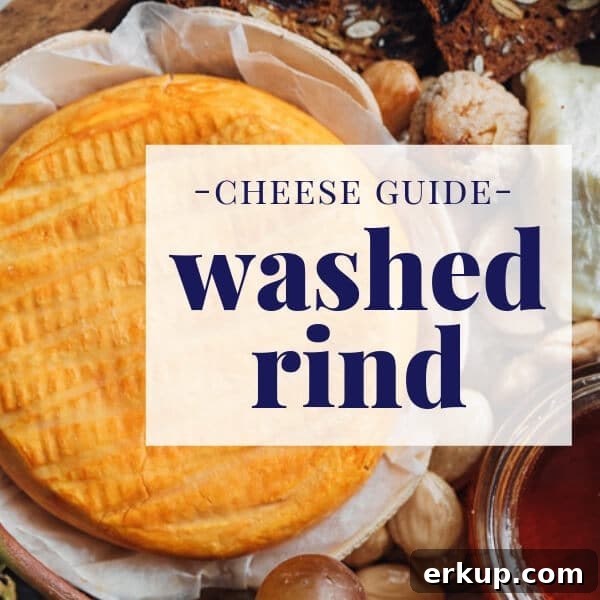
Get funky! Learn about washed-rind cheeses: what creates their characteristic aroma, common varieties at the cheese counter, and tips for serving them.

In this Post:
- What is Washed Rind Cheese?
- Types of Washed Rind Cheese
- Serving Washed Rind Cheese
What is Washed Rind Cheese?
Washed-rind cheese is aged with its exterior deliberately moistened: makers bathe, brush, or spray the rind with a saltwater brine or sometimes alcohols such as brandy, wine, or beer. This repeated washing encourages the growth of specific edible bacteria—most commonly Brevibacterium linens—while suppressing other molds and bacteria. The result is the orange-red, sticky rinds and the distinctive aromas associated with these cheeses.
Most washed-rind cheeses reach maturity in a few months, typically two to three, though some are aged considerably longer depending on the style and producer.
Why wash a rind? The washing introduces moisture and salt that favor desirable surface bacteria. Those bacteria ripen the paste from the outside inward and create savory, complex flavors and that characteristic aroma.
Where does B. linens come from? It can be present naturally in the aging environment, added to the milk at cheesemaking, or included in the wash solution in a process called smear-ripening. While this microbe contributes to strong scents, it is a normal, edible organism used by cheesemakers worldwide.

How strong is the smell?
Intensity varies. Washed-rind cheeses run the gamut from gently pungent to boldly assertive. Descriptions often liken the aroma to barnyard notes—hay, farm, or barn—and occasionally to sweaty socks or gym bag scents because some of the same bacteria live on human skin. That comparison can be off-putting, but it’s an honest description of certain aromatic qualities.
Despite the bold smell, the taste is usually much more pleasant and nuanced than you might expect. The rind’s bacteria develop deep savory, umami-rich flavors—nutty, meaty, earthy, or subtly sweet—often contrasting with how pungent the cheese smells.
Should you eat the rind?
Most washed rinds are technically edible, but their texture and flavor vary. Some rinds become sandy or develop a sharp, bitter edge; others remain pleasantly earthy and mushroomy. Whether to eat the rind is a matter of personal preference—ask your cheesemonger for a taste if you’re unsure.

Types of Washed Rind Cheese
Washed-rind cheeses span textures from very soft and oozy to semi-soft and even sliceable semi-hard. While cow’s milk is most common, you can also find varieties made from goat or sheep milk. Below are some popular examples you may encounter at a cheese counter.
Soft Varieties
- Epoisses (ay-PWOS); France: A famously oozy cow’s milk cheese with a reddish, brandy-washed rind and bold, meaty flavor. Serve ripe and spreadable on crusty bread.
- Livarot (LEEV-ah-roh); France: Creamy and runny at room temperature, Livarot offers nutty, spicy notes with a citrus lift. Traditionally wrapped with reed strips, it develops a savory, full flavor when ripe.
- Munster (Munster Géromé); France: From Alsace and Lorraine, this creamy cheese has a beefy, nutty flavor and a striking barnyard aroma; it dates back to monastic cheesemaking traditions.
- Stinking Bishop; United Kingdom: Washed with pear-fermented perry, this runny cow’s milk cheese has a strong aroma but a rich, rounded palate.
Semi-Soft Varieties
- Limburger (lim-bur-ger); Belgium, Germany, Netherlands: Smooth and mushroomy, Limburger is traditionally paired with rye or pumpernickel, mustard, and onions.
- Morbier (more-bee-ay); France: Recognizable by a line of edible ash through the center, Morbier is mild and slightly sweet with a gentle yeasty aroma.
- Taleggio (Tah-ledge-ee-oh); Italy: Lightly tangy and fruity, Taleggio melts beautifully; its rind can be quite pungent while the interior remains mild and creamy.
Semi-Hard Varieties
- Gruyère (groo-YAIR); Switzerland: A smear-ripened, aged cow’s milk cheese that offers nutty, aromatic, and salty flavors good for melting.
- Raclette (rah-KLETTE); Switzerland: Known for melting and scraping onto potatoes and charcuterie, Raclette has a nutty profile with a pronounced surface aroma.
Serving Washed Rind Cheese
When including a washed-rind cheese on a board, leave it off until just before serving and store it wrapped by itself in the refrigerator to prevent strong aromas from transferring to milder cheeses. Provide a dedicated knife for cutting or spreading each washed-rind cheese to avoid flavor crossover.
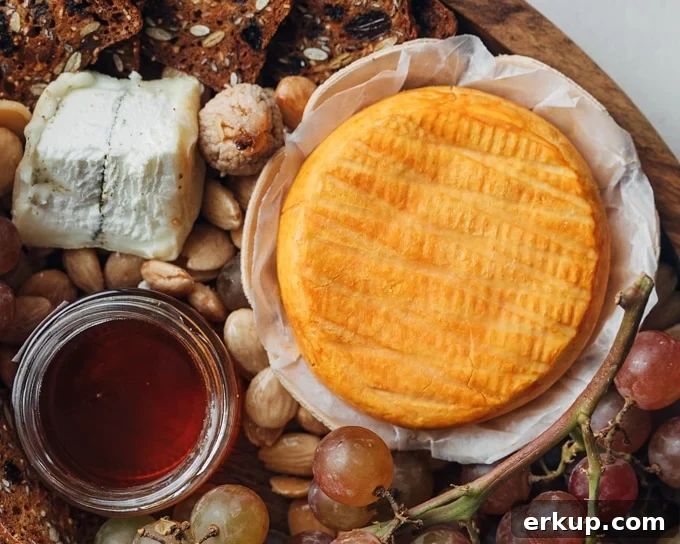
These cheeses usually taste best at room temperature or melted. On a cheeseboard they pair well with dark breads, rustic crackers, cured meats, fresh and dried fruits, and slightly sweet condiments that balance their savory intensity.
Explore more cheese varieties and tips in our Cheese Guides collection.